
Tide Pooling Log: Napili, Maui, HI, Day One

In previous trips to the Hawaiian islands, I had been somewhat disappointed with the tide pooling. The rocks were mostly dominated by brittle stars, urchins, and seemed to serve as nurseries for reef fish. They appeared entirely homogenous, and I focused more on snorkeling.
But this most recent trip to Maui, I was determined to find good tide pooling. Much of the coastline is made up of volcanic rock, but finding large areas of bedrock that created pools instead of large boulders piled in the sand was difficult. I had messaged a few fellow tide poolers on iNat who had observations in the area I was visiting and gathered some excellent information.
I went alone that morning, earlier than the others within the seven o’clock hour. The north side of Napili Bay was where I heard was the best. I followed careful instructions from the @Sea_kangaroo and after a bit of scrambling, made it to a large pool. The sun was already warm and a rainbow wained lazily to the east from the morning rain, fading in and out of the clouds. I was so excited; here I was sure to find all kinds of fascinating creatures. I so wanted to find a “nutoome” (new-to-me), as my husband calls the lifer nudibranchs species I find. As I waded in the water, many baby reef fish swam around my legs; a sea cucumber and urchin were scattered here and there; I saw a few flat rock crabs (Percnon planissimum) filter feeding with only their green and yellow edged heads and a leg or two showing. But after about an hour of searching, I had little to show for it. The tide wasn’t extremely low and I only had a consistent 20 seconds of still water to search before another wave obscured my few.

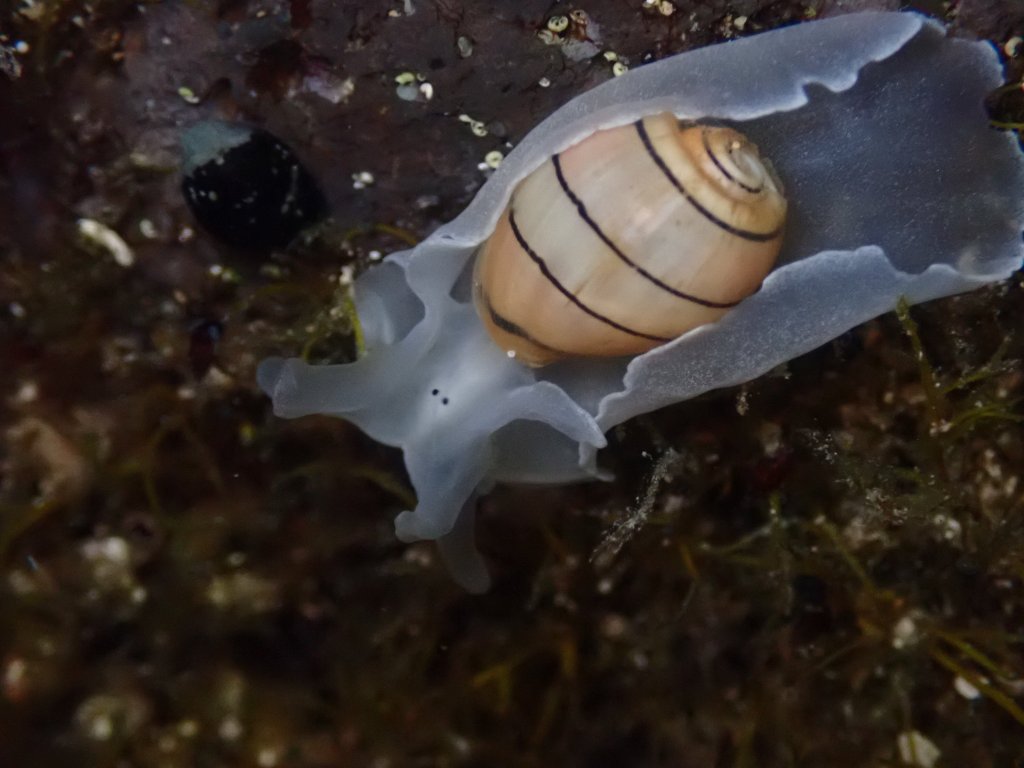
Just before heading to the south side of the bay, I noticed an emerald bubble (Smaragdinella calyculata). These high intertidal slugs in the headshield family graze on algae and secrete a mucus to keep from drying out. This one is in such a tiny pool that it was difficult to get even my lens under the water to take pictures. He was very cute, but I was still a little disappointed at my finds overall.

On the south side of the bay, the pools were more extensive and protected from the waves despite the tide now coming in. I flipped a few small stones before I encountered a warty seacat (Dolabrifera dolabrifera) and its eggs. Also known as common sea hares, I was super excited to find this slug and spent a few minutes with it before placing the rock face down again. It was obvious the slug didn’t like the light; when I first picked the rock up, it scrunched up and then began moving toward the edge to escape underneath. After a new more urchins and hermit crabs, we left the pools and went snorkeling.

That night, we decided to go back to the south side of the bay and take another look at the rocks. The tide was going to be about a foot lower and I knew that some had encountered amazing animals at night. I was hoping for the best after the somewhat disappointing show during the day. We passed only one other person after walking across the dark beach and doing some scrambling to get up to the bedrock. We starting exploring with our headlamps. A black crown night heron (Nycticorax nycticorax) was the only other visitor to the shore that night. Everything else was quiet.

Immediately, I noticed them everywhere: warty sea cats. The single slug I had seen that morning might have multiplied by a hundred, except they were all different patterns. None more than 3 inches long, these master’s of camouflage came in clumps; when I knelt to take a photo of one, three more materialized out of the rock. Moving along in their inch worm style, I soon stopped taking photos of every one because there were so many. They dominated the pools for the first hundreds or so feet from the beach.


Next, I noticed three pink bubble snails, nocturnal slugs that I knew were present because I had seen their shells on the beach. The body of these snails is too big to fit inside its delicate shell so their mantle is always extended in paper thin sheets and waves. Two little eye spots make a face that reminds me of piglet.
While snagging some photos of one of the bubble snails, I saw this bumpy, folded up on itself, black and white blob. It had the consistency of a mollusk or worm when I touched it, but I could see any rhinophores or definite body shape.


I shot a ton of photos and videos, but it wasn’t until much later that I found out what it was. A very helpful Cory Pittman (of seaslugsofhawaii.com) directed me to a page on John Hoover’s website (whose book, A Guide to Hawaii’s Marine Invertebrates, I bought and used a ton while there). The unusual flatworm genus matched my photos exactly, except that it appeared to be folded in on itself as if digesting food. I exchanged a few emails with John and found that this was the first observation of the worm in the intertidal as the other observations he had note of where while scuba diving. I hope this worm can be identified or described soon! Check out this page for more information.
It was about this time that I started to notice eery little eyes just barely visible before they would vanish. Tiny pairs of orange specks drifting in the water around me feet when I shined my headlamp on them. They seemed to dancing; I couldn’t tell if they were swimming or crawling but when I looked closer, they vanished. My camera didn’t yield much either as it had nothing to focus on. But finally, I stayed still enough that one was fooled and didn’t swim away: transparent shrimp. Literally hundreds of them. I never got anything better than a mediocre photo so I am unsure what species they were, but they were very ubiquitous and curious as shrimp go. This was the best photo I was able to get.

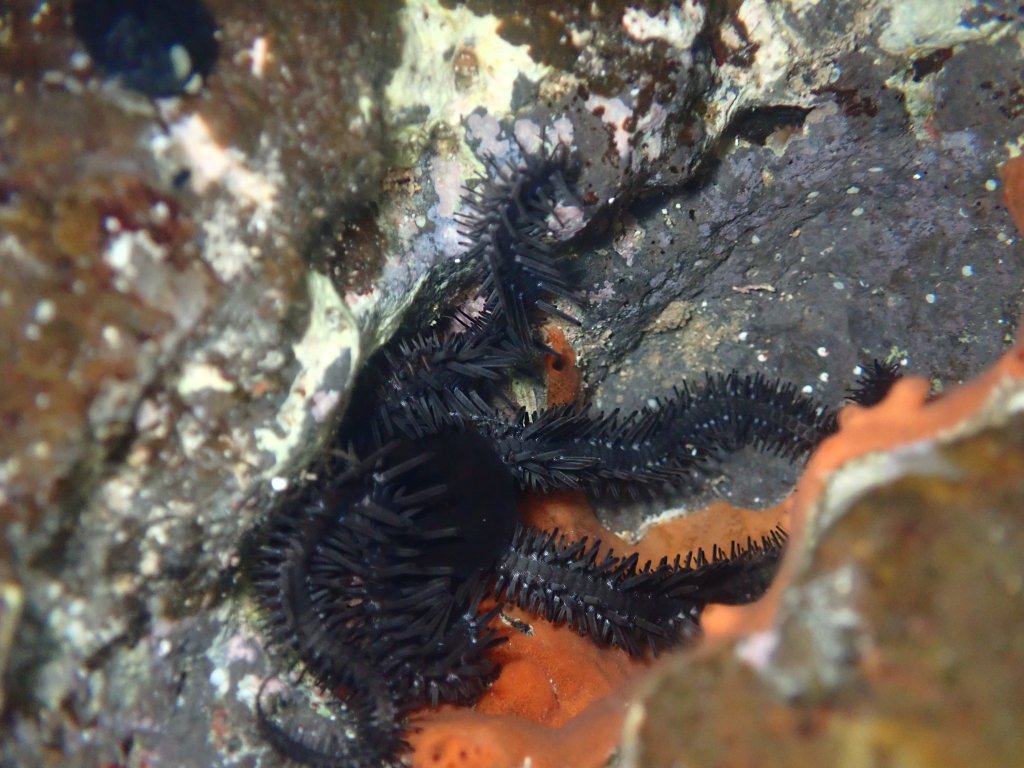
We had covered a fair amount of ground by down when suddenly, the warty seacats ceased. I read later that this species is abundant in some areas and absent in others. There was no visible change in the substate, but a new master of the rocks emerged: brittle stars. There were just as many as there had been seacats, now tucked into the crevices with their bristled, jet black arms recoiling at my soft touch.
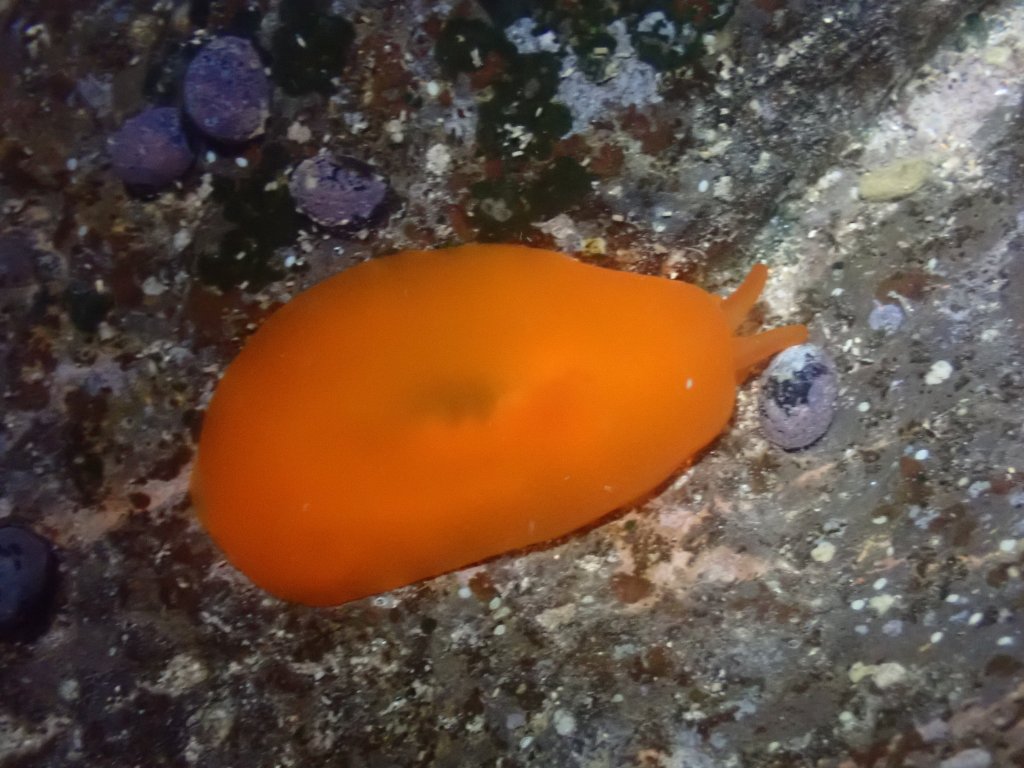
It seemed like the pools at this particular beach were homogenous within themselves, but anything except uniform between each other. In another pool, I saw my first, second, third, fourth, and I stopped counting, orange gumdrops (Berthellina delicata), very aptly named sidegill slugs. But they were only in a single large pool! No where else that I saw on the rocks. This is also a nocturnal species.

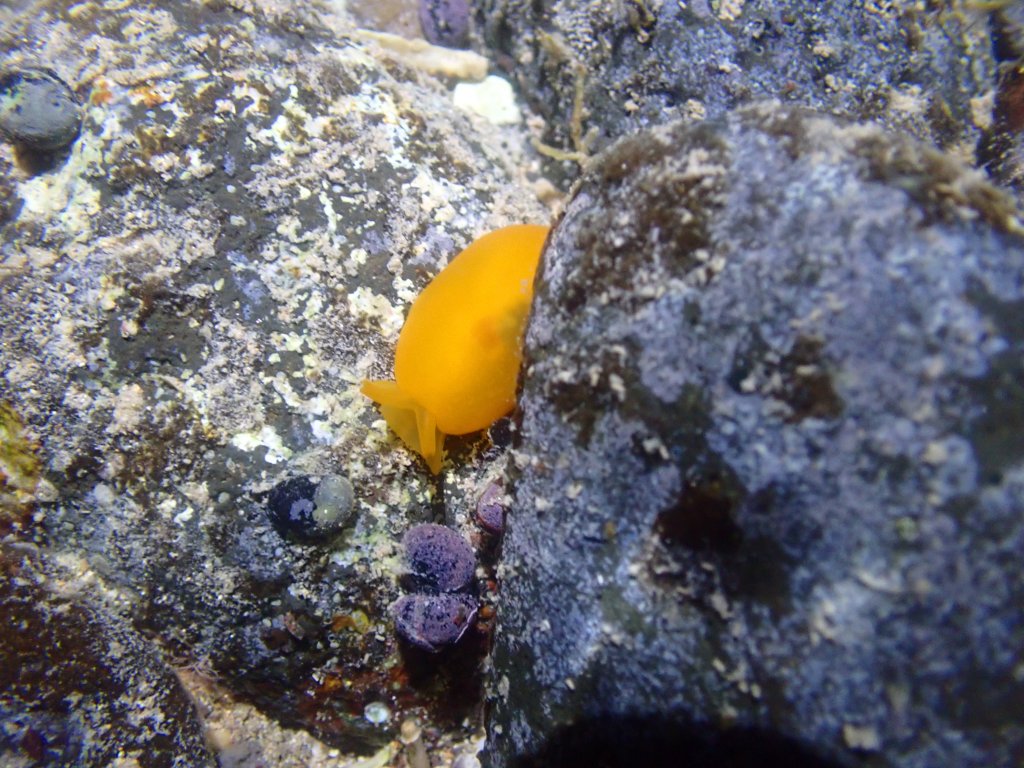
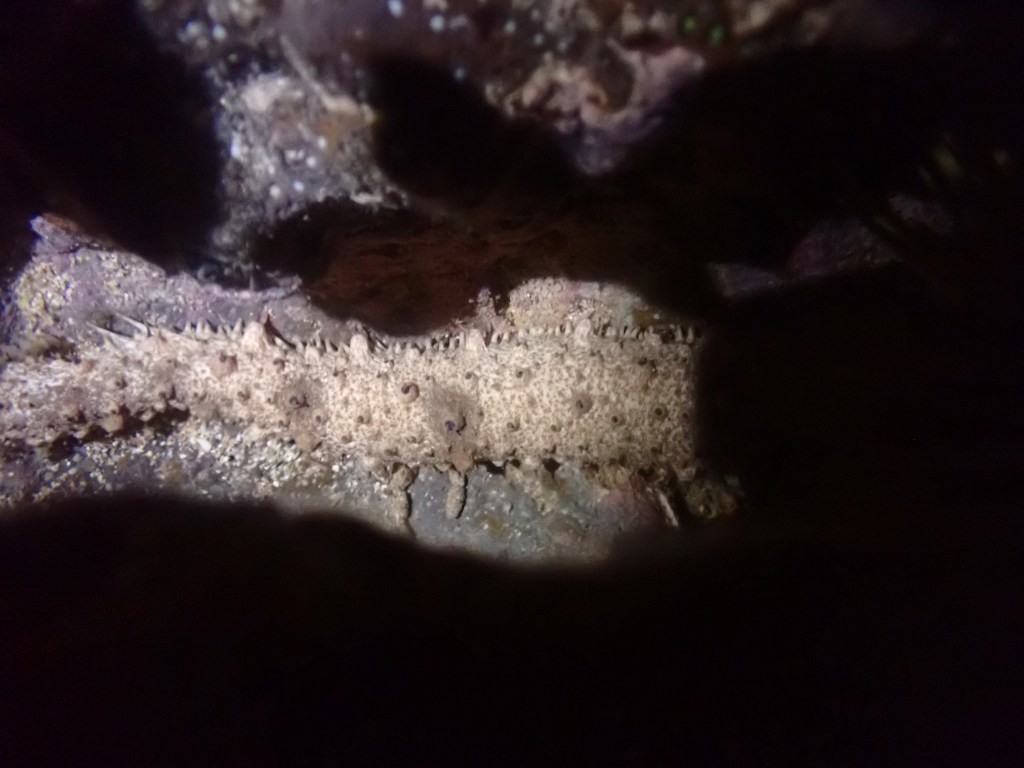
The sea cucumbers were a exception to this rule; they were everywhere. Just like they had been during the day. Apparently sea cucumbers never sleep.

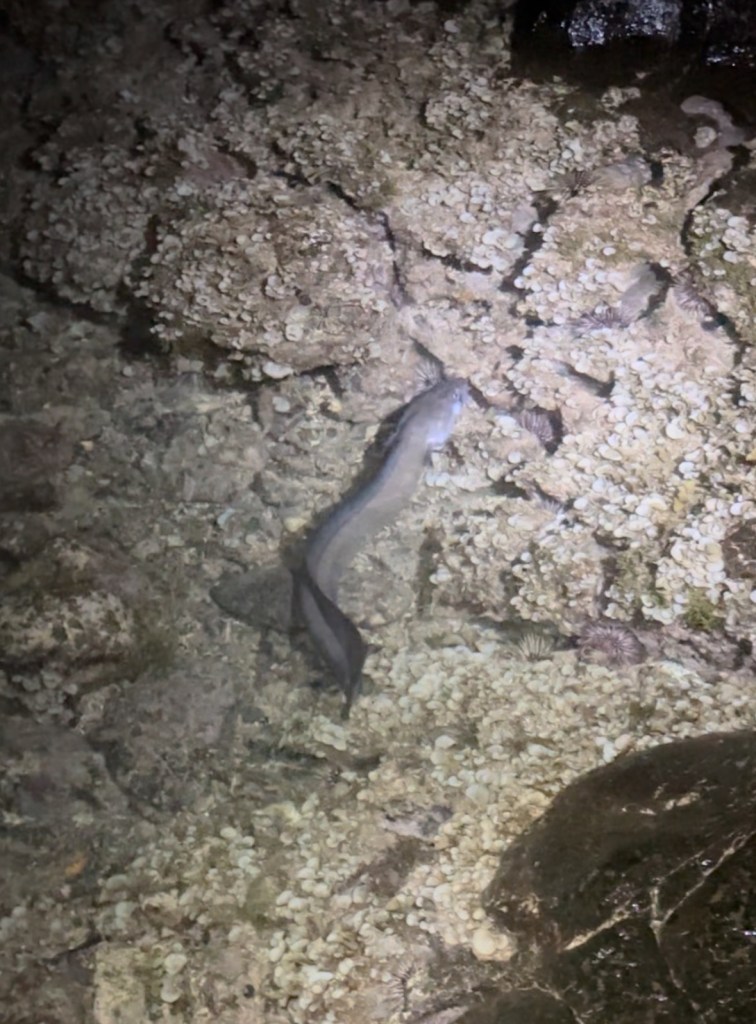
We also saw several varieties of moray eels that night, mostly hiding under rocks with only their heads exposed, rhythmically opening and closing their mouths in moray eel fashion. We also spied a conger eel out in the open that choked down a fish before swimming off into the blackness. It was probably a Hawai’ian mustache conger eel (Conger marginatus), but I didn’t see it close enough to be sure.
The nudibranchs that night did not disappoint either. This species is a Lavender or lilac spotted dorid, depending on what common name you prefer. It was difficult to take photos of though because its spots are diffuse and appear blurry in the photos. This is a relatively common nocturnal species and was in the same pool as all the orange gumdrops. I also spied a couple black doris slugs that were fairly nondescript, but still cool.

Perhaps the crown of the evening, however, was the jeweled anemone crab, the largest hermit crab I’ve ever seen bedecked with large anemones. I had seen a few observations of this species, but never thought a) I’d be lucky enough to see one and b) it was so big! About the size of my hand, this animal was very impressive looking, but scuttled away from our headlamps. I got a couple shots but mostly video as my camera was struggling to focus.

It had begun to drizzle on us and we decided it was time to head back. I saw a shooting star through the clouds as we were walking out.

Categories
tags
Subscribe to the blog
Sign up to receive weekly emails with tide pooling information and guides so you never miss a post!
 The Tide Is Out
Leave a reply to Tide Pooling Log: Napili, Maui, HI, Day 2 – The Tidepooler Cancel reply