
The Tides, the Moon, and the Sun

The ocean is the opposite of stagnant; it is constantly in motion. Some of this motion is facilitated by deep water currents, hydrothermal vents, and surface winds. But much of the ocean’s movement comes from the tides, the rising and falling of ocean levels each day relative to the shore.
The tides are a fascinating phenomenon, but how do they work? Why do they happen twice every day? And what causes the tides?
Look no further for all the information you need about how the moon and the sun create our ocean’s tides.
Why the Ocean Has Tides
The ocean’s tides are caused by the gravitational pulls of the moon and the sun, about 2/3 from the moon and 1/3 from the sun. Despite being so far away, these celestial bodies exert gravity on the earth. The sun is big enough that the earth orbits it; the earth is big enough that the moon orbits it.
While you may not be able to feel the gravity of the moon from the earth, the oceans can. Because the ocean is a massive body of water, the gravity of both the moon and the sun pulls the water in different directions. This is called the tidal bulge. For me sitting on the beach or exploring the tide pools, this means that the waves are coming nearer to me or moving away from me.
Because the earth makes a full rotation once a day, there are typically two low tides and two high tides each day on any given beach as that part of the world passes through where the moon’s gravitational pull is the strongest and the weakness, creating bulges of water across the globe.
The tides keep the waters of the ocean moving and thus bring new nutrients from deeper, colder waters into shallow, warmer waters each day. Without the tides, much of the algae that produces the oxygen we breathe would die, so you better be thankful for the tides.
Why the Tidal Range Changes
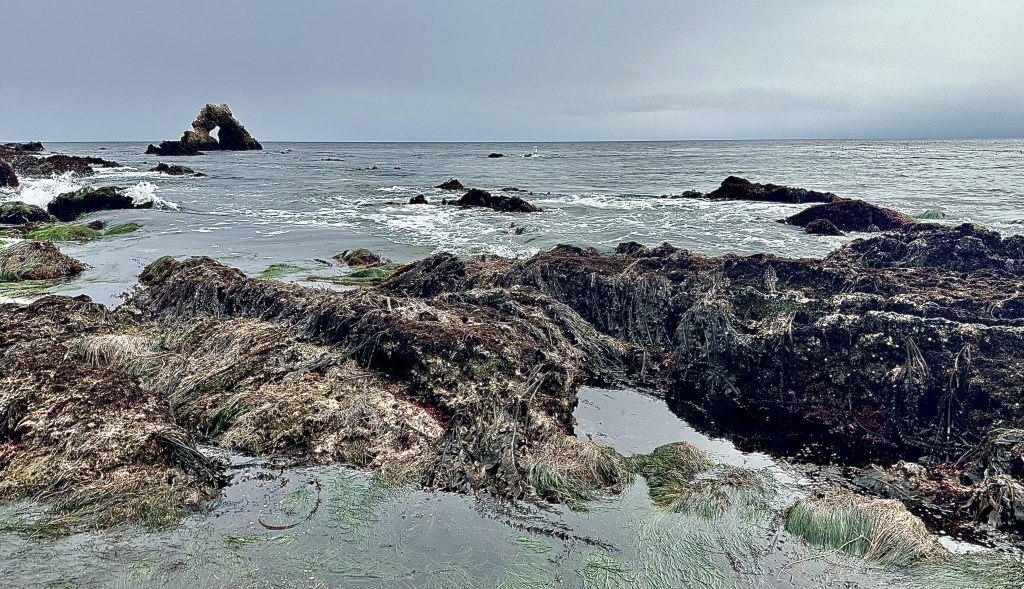
You may have noticed that despite there being two low tides a day, not all tides are equal. Some high tides are higher than others, and some low tides are lower than others. Because the lowest tides are the best for tide pooling, it’s a good idea to watch a tide chart to see when the lowest tides will be. Typically, they fall when there is a full moon or a new moon.
But why does the tidal range fluctuate? This is the result of two different factors.
1. Moon’s Elliptical Orbit
Saying that moon has an elliptical orbit is a fancy way to say that the moon goes around the earth in an oval instead of a perfect circle. Because of this, the moon is closer to the earth on some days and farther away on others. Gravitational force is impacted by proximity of objects, so when the moon is closer to the earth, the ocean feels a bigger pull.
The moon is at its closest point to earth (it’s perigree) when it’s a full moon or a new moon, so these phases of the moon will create the biggest lunar tides. These are called spring tides.
2. The Sun’s Gravitational Pull
The second reason the spring tides occur when the moon is full or new is because of the solar tides, i.e. the tides that result from the sun’s gravitational pull. Despite being so much bigger, the sun doesn’t impact our tides as much as the moon does because it is so much farther away. However, the sun’s gravity does contribute about 1/3 of the fluctuations of our tides; this is called the solar tide.
The solar tide is not measured separately from the lunar tide. However, when the moon is full or new, the sun and moon’s gravity pulls in the same direction instead of against each other. This mutual force creates bigger tides because there is more gravity pulling on the water.
Who Cares?
You might be asking why this matters. For tide poolers, the changing of the tide either allows us to see the animals that live in the tide pools or covers them in water and keeps them out of sight. It’s always important to look at a tide chart when you can to see when the best tides will be. There are also a variety of apps that you can use to track the tides. If you can’t get your hands on any of these methods, you can always look at the moon and know that the tides will be the biggest when it’s full or new.
Perhaps this is of more interest to those into astronomy tahn of tide pooling, but it’s worth while to know how the tides work— the things that make tide pooling possible.

Categories
tags
Subscribe to the blog
Sign up to receive weekly emails with tide pooling information and guides so you never miss a post!
More like this
Helpful Definitions
- Tide: Rise and fall of sea levels due to the moon and sun’s gravitational pull
- Full moon: When the entire sphere of the moon is illuminated by the sun
- New moon: When none of the moon’s sphere is illuminated by the sun
- Lunar tide: Tide caused by the moon’s gravitational pull
- Solar tide: Tide caused by the sun’s gravitational pull
- Tidal range: The difference between the water line at low tide and high tide
- Tidal Bulge: The result of the gravitational pulls of the moon and sun on the earth’s ocean’s. Astronomical description of the tides.
- Perigree: The point in the moon’s orbit around the earth that is closest to the earth’s center (on new and full moon)
- Spring tides: When the tidal height has the greatest change
- Neap tides: When the tidal height has the least change


 The Tide Is Out
Leave a reply to Kassidy Wilkins Cancel reply