
Sea-not-quite slugs: Trivia, Erato, and Allies

Over the past several months, I’ve taken a deep dive into marine gastropod taxonomy. Riveting, I know, but I find that the more I know about these creatures, the more interesting they become and the more likely I am to find them while tide pooling.
Particularly, I’ve recently been interested in the superfamily Velutinoidea, more commonly called the trivias, eratos and allies. If these marine snails haven’t been on your radar, I suppose I can forgive you because the family contains mostly small animals with internal shells that can often be entirely covered by the mantle, or fleshy part of the animal. Most of these shells are so small and delicate that they rarely make it through the waves to the shore where a beachgoer or sheller might find them. Their mantle gives them a slug-like appearance, although there are significant anatomical differences between these animals and “true” sea slugs. However, many species are specialized predators of sea squirts, much like nudibranchs. Their small size makes them somewhat inconspicuous, but their mantles are often intricately patterned and/or textured if you get close enough to notice. Most have a tall siphon near the head that draws in water for respiration and makes them resemble tiny elephants with raised trunks.
Because the animals are small and often uncommon in their regions, this group has significant holes in scientific research, with many documented but undescribed species. We’ll look at each of the three families within Velutinoidea on their own and give some examples of species you can see in California tide pools.
Bean Cowries (Family Triviidae)
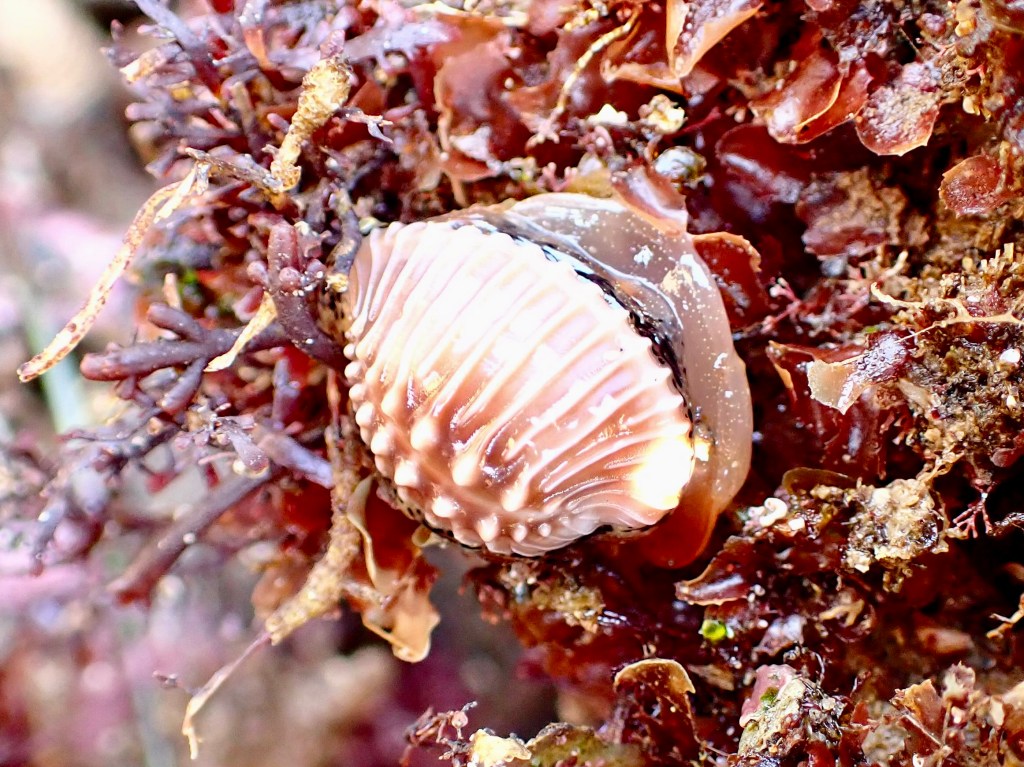
The bean cowries, or trivias, are perhaps the most well-known family in the superfamily Velutinoidea, but that is not saying much. Their name (Triviidae) means abundant or commonplace, although there are few areas around the world where they are so. The group superficially resembles cowries (family Cypraeidae) but are much smaller, with shells shaped and often the size of a bean. The trivias usually have larger and harder shells than other families in the superfamily, and will often be seen with their shell exposed if out of the water in the intertidal. Most prey on sea squirts (tunicates) and can be found in temperate, subtropical and tropical waters throughout the world.
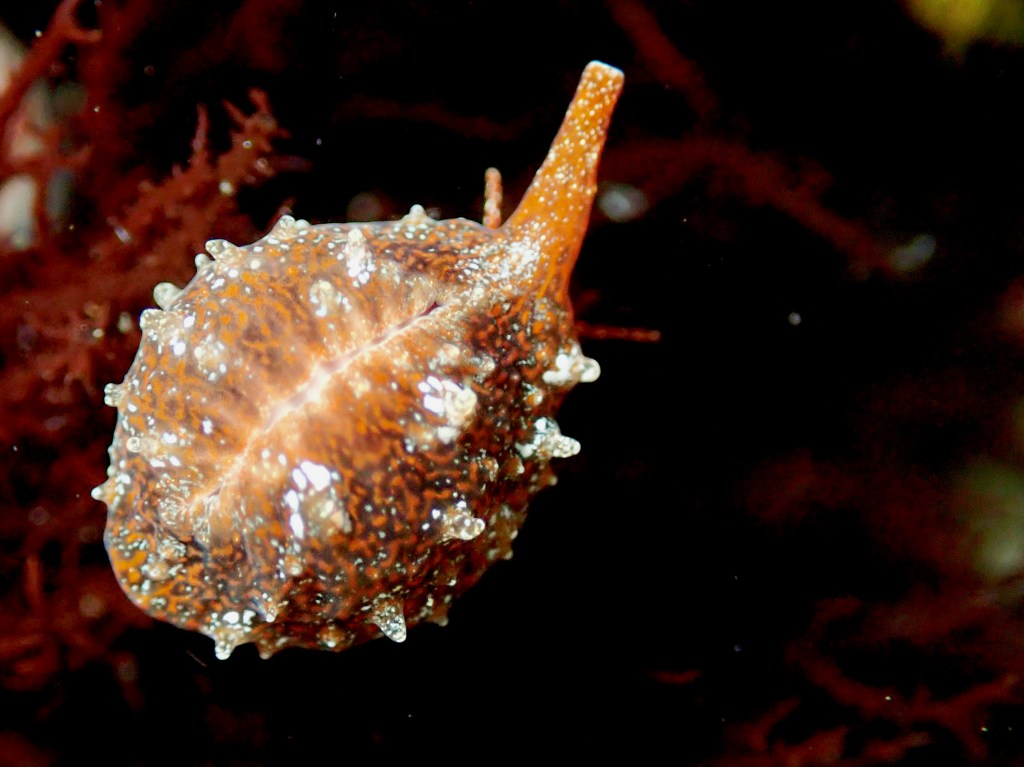
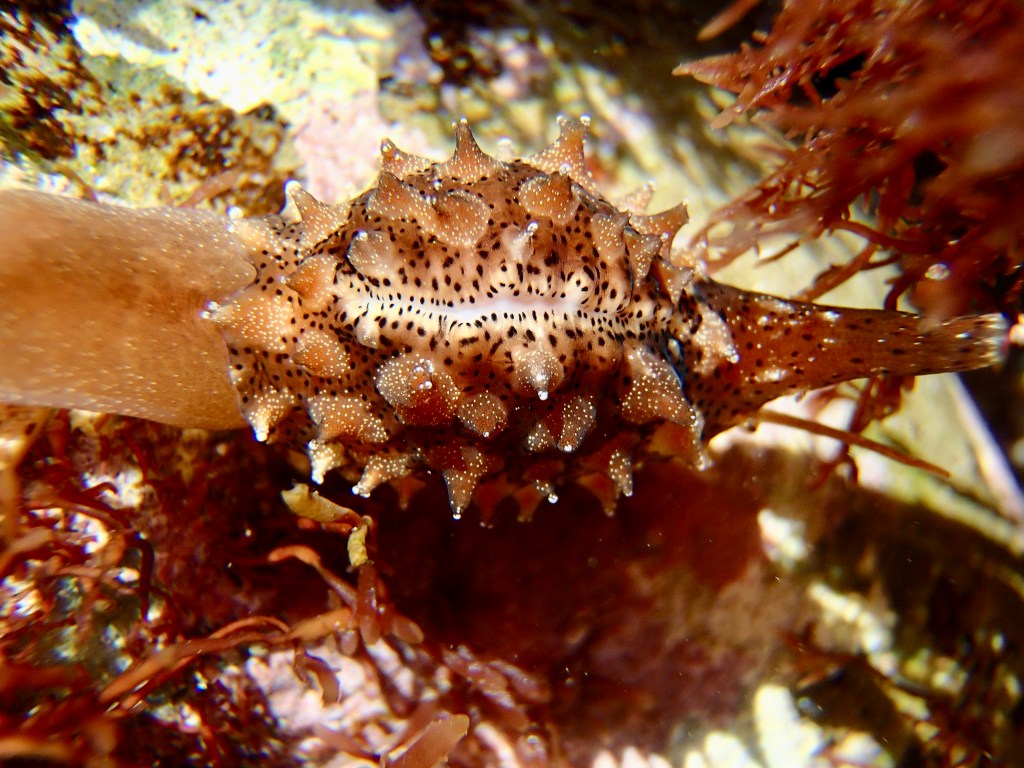
Only two common species of trivia are found on the western coast of the United States, along with several other, far less common animals. Both the common varieties can be found in the mid to low intertidal. They are the Solander’s trivia (Pusula solandri) and the coffee bean trivia (Pseudopusula californiana). While the shells of these two snails are quite difficult to tell apart without practice, the live snails are rather distinct as the Solander’s is bigger, usually a duller orange or brown in color, with larger and bulbous papillae flecked with white and outlined with black spots. The coffee bean is smaller, redder in color, and has small, usually white, papillae surrounded by rosettes, spots or squiggles. If the shell is exposed on a live animal, the Solander’s has a deeper central groove and is more gray than the gray-purple shell of the coffee bean. I have seen Solander’s trivias over an inch and a half long from head to tail, but their shells are smaller than the living animal. Coffee bean trivias I’ve observed live to about an inch long.
Erato and Allies (Family Eratoidae)
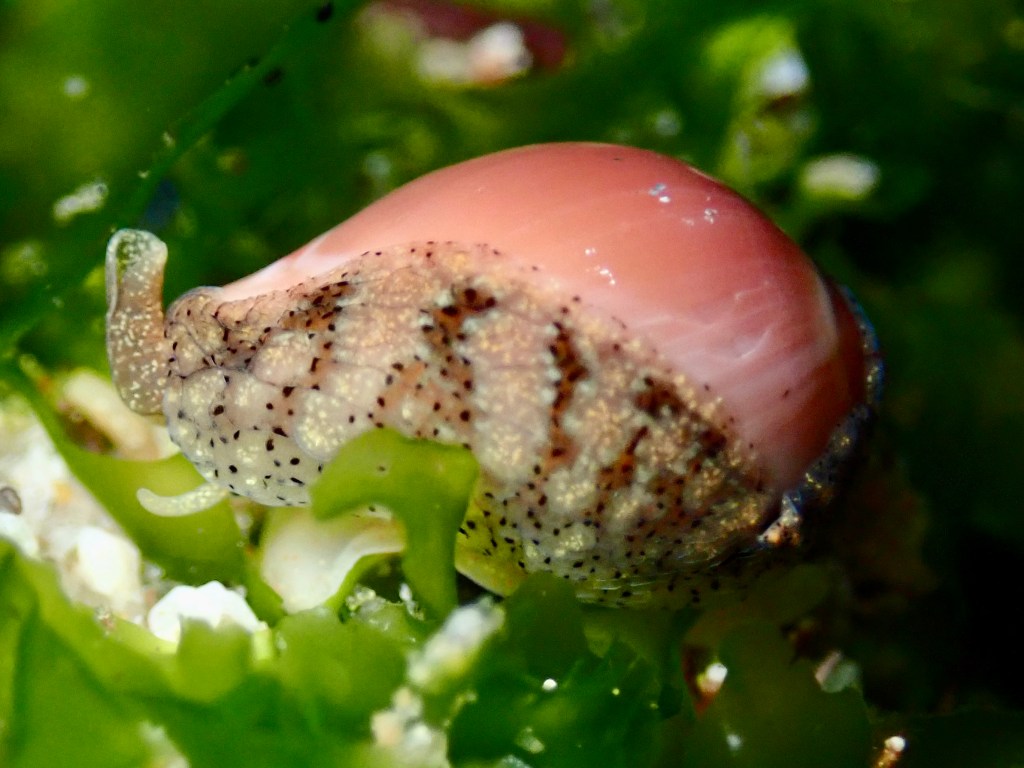
The erato family is much smaller than the trivias, with only 12 species recorded throughout the world on iNaturalist, a very well-known and used citizen science platform. They are also predatory sea snails, similar to trivias in their cowry-shaped shells with mantles that can extend to cover the entire shell. While trivias often have grooved shells, eratos usually have smooth shells.
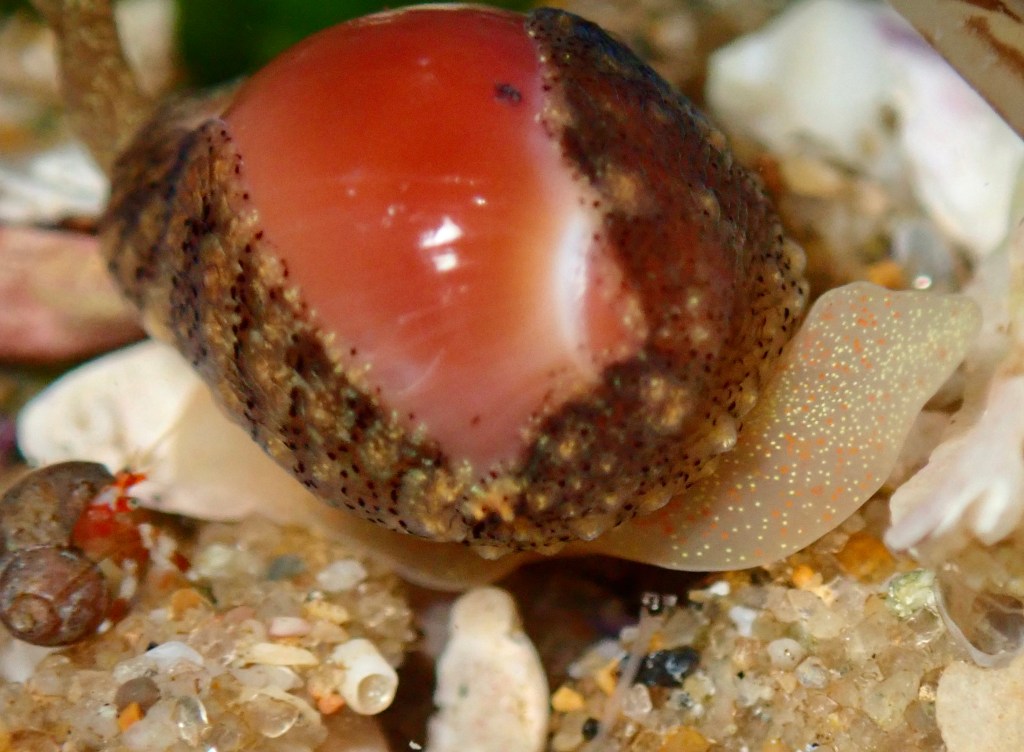
There is relatively little information readily accessible about this family. The name comes from the Greek muse of the same name and means lovely or desirable. Obviously, whoever first named these creatures thought they were very beautiful. The eastern Pacific is home to only two described erato species. The appleseed erato (Hespererato vitellina) inhabits most of the California coast and boasts a small, peachy to reddish shell and a colorful mantle, often flecked in green, white, black, orange and/or brown, and small papillae. Their tough shells can sometimes be found washed ashore, battered almost beyond recognition. Live animals can be found in the low intertidal on rocky shores, but are not common and require persistent searching or an above-average dose of luck to find. Pigeon eratos (Archierato columbella) are much less common and harder to find. They have a similar-shaped, caramel colored shell and a mantle of browns, greens, and blues.
Family Velutinidae
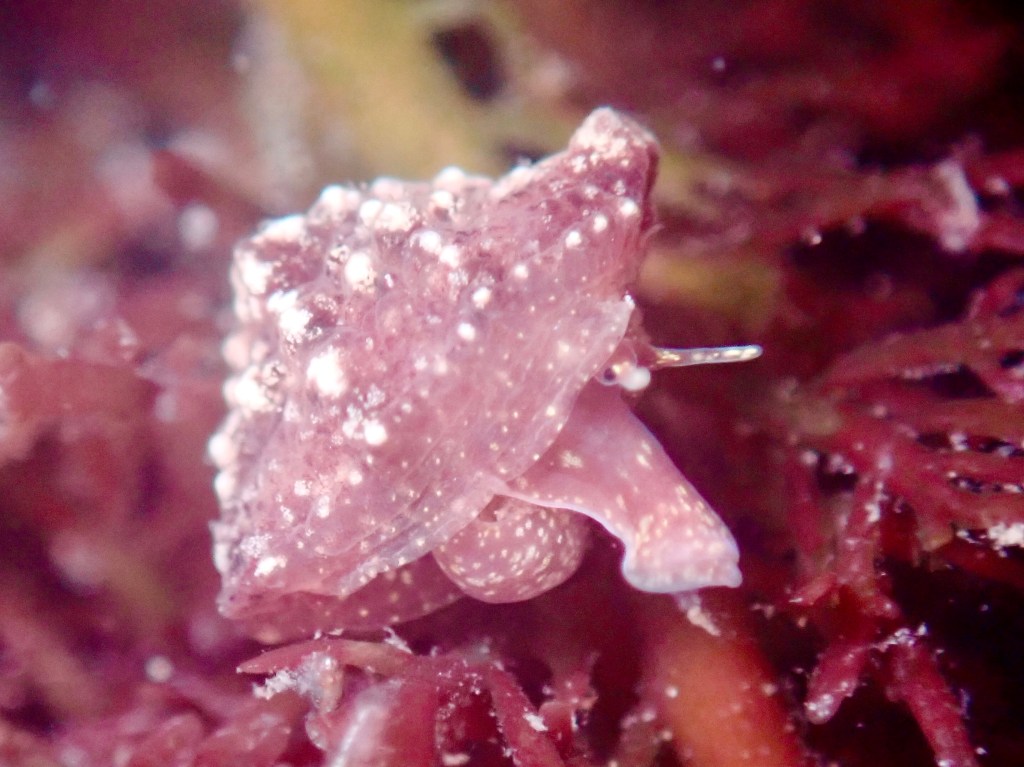
The last family within the superfamily Velutinoidea is the family Velutinidae, which doesn’t have a common name. Mollusks in this family have the most reduced shells of any of the groups we’ve looked at, with most species having no visible shell at all, covering it entirely with the mantle. While the trivias and the eratos have a split in their mantle, allowing it to extend to meet at the top of their shells or retract to expose their shells, many animals in the family Velutinidae have no such option as their internal shells are shaped like a “traditional” snail’s in flattened whorls instead of like cowry shells. These make them look more like dorid nudibranchs than the other two groups we’ve discussed, and they are often mistaken for sea slugs. Key differences are velutinidae’s anterior siphon and head tentacles and the lack of a gill plume.
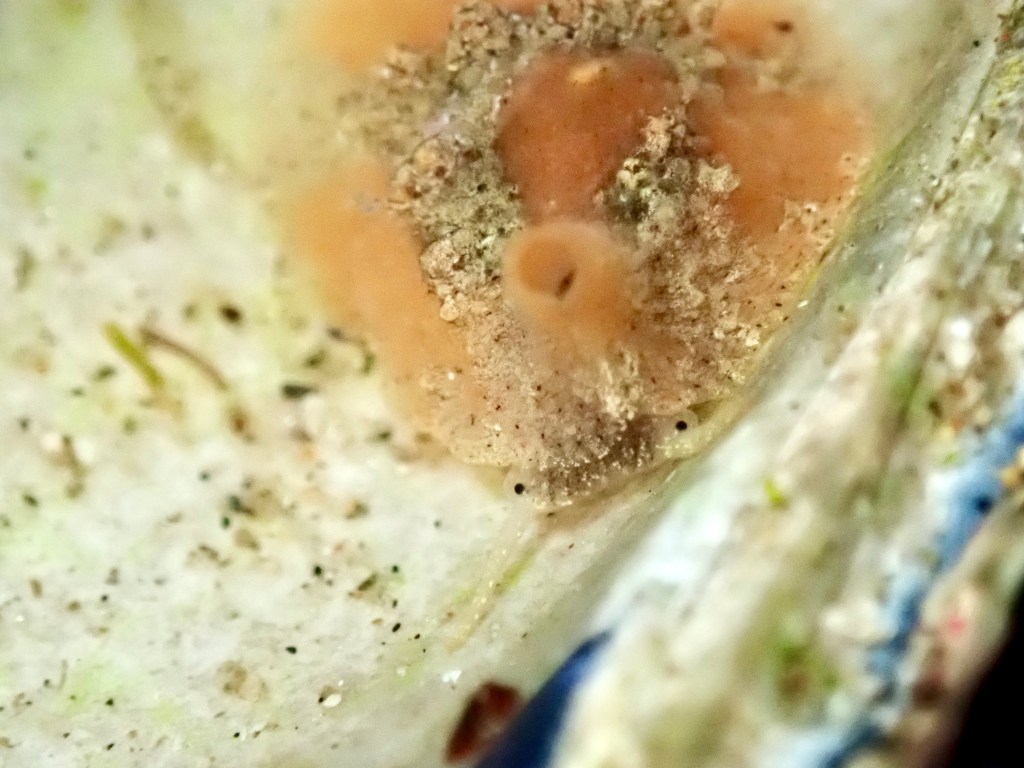
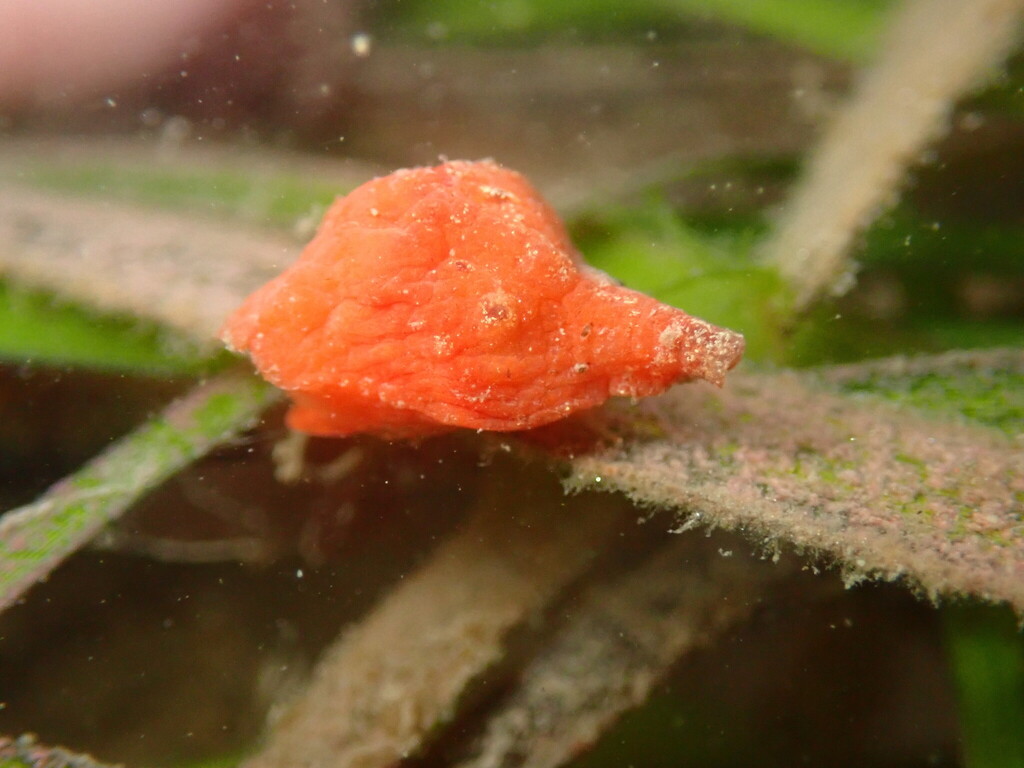
In California, there are several species of Velutinids that can be found in the intertidal. None are very common and few have widely used common names. Hainotis sharonae is the most frequently seen and has a variety of color morphs from brick red to dull purple, orange, yellow, white and even a purple-black. While this species is rather upright and trivia-shaped, most others are flattened. Many are cryptic and camouflage beautifully with the tunicates on which they live and feed, like Marsenina stearnsii, which matches its prey down to its porous texture.
There is much room for research within the Velutinids, as many animals have been photographed but not yet formally described.

Categories
tags
Subscribe to the blog
Sign up to receive weekly emails with tide pooling information and guides so you never miss a post!
 The Tide Is Out
Leave a comment