
How Are Tides Measured and What Do The Numbers Mean?

Understanding how tides are measured and what they are measuring is crucial for the tide pooler. The tides are what allow you to explore the intertidal, so understanding how we quantify their function is incredibly useful knowledge, especially when planning your tide pooling adventure. You can read this article to learn how the tides function astronomically or this article about what tides are good for tide pooling, but here we’ll discuss how tides are measured and what they are actually measuring.
What Tidal Charts Are Measuring
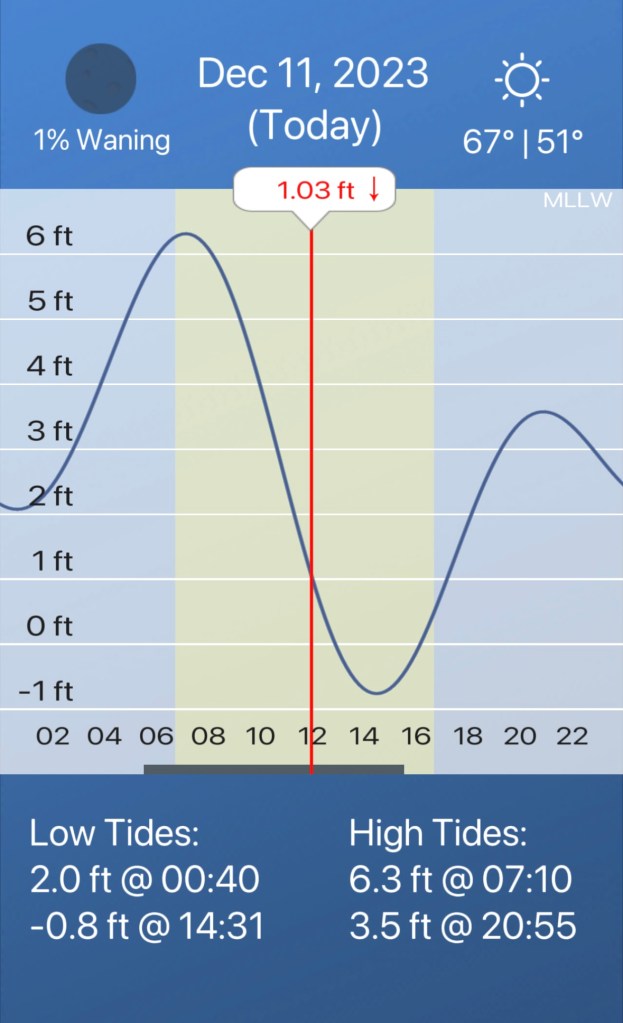
Tidal charts measure ocean water levels. Ok, but what does that mean? Many people hear this and incorrectly assume that tides are measured horizontally, as opposed to vertically. For years as a child and teenager, I thought that the height of the tides measured the distance the water came up the beach. So if the tide was 0.0ft at 9am and 4.5ft at 3pm, the water would be 4.5 feet closer to my beach chair at 3pm than it had been at 9am. This is what measuring tides horizontally would look like.
However, this is not what a tide chart is measuring. Tidal charts measure the vertical water height of the current ocean level compared to a specific point. Ok, but that sounds a bit technical. Let’s look at it in contrast to my horizontal misunderstanding. Instead of measuring horizontal water movement up the beach, tidal charts measure vertical water height (depth) over a specific spot. For example, if I am standing at the water’s edge when the tide is 0.0ft, I would be standing in 4 feet of water (up to my waist) by the time the tide was at 4.0ft. Much like a snow marker measuring the depth of snow at that particular point, the tidal height measures the depth of the water at a particular point.
Given this distinction, it makes sense that a 6ft swing in tidal height can swallow up a 40 foot wide beach. It also allows for large boulders in rocky intertidal areas to be submerged at high tide but entirely exposed at low tide.
What A 0.0ft Tide Means

In order for the tidal height to be a meaningful measurement, you have to choose a reference point that you can consistently measure the current tide against. To borrow from our snow marker example, the spot on the mountain that the marker is placed is the reference point. The tidal height reference point is the low astronomical mean water level and is defined at 0.0ft. The mean here is the mathematical average of all low water levels throughout a year. This is really just a fancy way of saying that 0.0ft is the typical low tide.
Making 0.0ft the consistent tidal reference point gives meaning to negative tides when the water drops below the average low tide level and the highest positive tides when the water rises beyond typical levels.
How Tides are Practically Measured
In the past, most tidal gauges used mechanical floats and recorders to measures tidal changes on particular coast. Now, many gauges have been updated to take more precise and accurate readings by using sounding tools as well as measuring currents, wind, weather, and many other oceanic factors that can impact tide height. Read this article published by NOAA for more information about the process of taking tidal recordings.

Categories
tags
Subscribe to the blog
Sign up to receive weekly emails with tide pooling information and guides so you never miss a post!
 The Tide Is Out
Leave a comment