
The Pacific Intertidal Keystone: Ochre Sea stars

Sea stars are a fan favorite, especially among children visiting the tide pools for a variety of reasons including size, color, and texture. In SoCal, it used to be that you were almost guaranteed to see an ochre sea star on a visit to the tide pools. Such is not the case anymore in our area, but hopefully they will be making a come back as great as they have made in the Pacific North West. Despite having no brain and being relatively simply creature, ochres are ravenous hunters, have a complicated ecology, and are a keystone species in the rocky intertidal.
Quick Facts
- Their name “ochre” is the name of a earthy, burnt orange pigment that derives its color from iron oxide. Some individuals display this coloration but most are a royal purple.
- Ochres are a keystone species meaning that their health is a indicator of the general health of the ecosystem.
- Sea stars are echinoderms, related to sea urchins, sea cucumbers, and sand dollars
- A group of sea stars is called a “galaxy.”
- Other common names include purple sea star and common Pacific sea star.
Appearance

Ochres are a large, five armed species of star with their arms growing up to ten inches in length. The arms are arranged around a rough central disc where basic nervous signals are processed and where the creatures mouth is on the underside of the animal. On the underside of the arms is the star’s method of locomotion: tube feet. Thousands of tiny tube feet each ending in a small suction cup reach, stick, pull, and release asynchronously to move the ochre across the ocean floor. These animals, like most in the tide pools, are benthic.
Most ochres are a deep, royal shade of purple, but they can be bright orange, burgundy, or red-brown. Their exterior also has tiny spines which appear to be white dots and feel to the human skin like nothing more than bumps. These spines are actually tiny pinches that can remove algal growth from the star’s body. While the ochre does not technically have eyes, it does have small light sensing spots on the ends of its arms. These are mostly used to detect areas of shade for shelter from the sun or crevices where it can hide from predators.
Diet

The ochre sea star is a voracious hunter and although they don’t move fast, is one of the top predators in the tide pools. Preying predominantly on mussels, ochres will also eat clams, urchins, barnacles, and snails if it can get to them. Many of these sessile animals require strong water flow to feed, but the ochre is well equipped for areas with high wave shock as its tube feet are strong enough to anchor itself to the rock as well as rip apart the shells of its prey (an impressive feat, you’ll know if you’re ever tried to open a live mussel, perhaps for bait when fishing, with your bare hands).
Once an ochre has found its prey and pried open the shell, it pushes its own stomach out of its body and lays it over the prey. The digestive juices then begin to work outside the body, dissolving the flesh and absorbing the nutrients. This process can take up to several days.
Ochres control mussel populations; without them, large beds of mussels take over the intertidal and smother other species. This is one of the reasons the ochre is a keystone species, as its presence or absence greatly contributes to intertidal diversity. In fact, the ochre is such a controlling factor in mussel populations that the California mussel typically grows in a zone above where it can efficiently reproduce and feed because it is above the highest zone of the ochre.
Ochres have few natural predators. Sea otters, while better known for preying on urchins, will eat ochres, but the fur trade and other human activity have driven otters far from their natural range. Sea gulls will also eat small ochres if they are able to detach them from the rocks.
Habitat and Range

Ochre sea stars can be found from low intertidal zone to a depth of nearly 300 ft. During low tide, they especially like hanging out under rock ledges and in the shade in groups to keep out of the sun. These galaxies, as they are called, can have dozens of individuals, sometimes all pilled on top of one another, presumably to retain moisture.
Ochres range from Baja California to the Aleutian Islands in Alaska. While they used to be very prominent in Southern California, several events of sea star wasting disease in the last decade have severely depleted their numbers. The cause of the disease is unknown, but stars that are infected begin to literally “waste” away and deteriorate. While ochres are starting to regain number in California, they are not nearly back to where they were when I was a child. In the PNW, however, ochres have had a stronger comeback; I probably saw over a hundred in one visit to the intertidal in Ketchikan, AK.

If you visit the intertidal, there’s a good chance you’ll see ochres out of the water, waiting for high tide to return so they can feed. While some species of sea stars die quickly when exposed to air, ochres do just fine in the shade or under algae for up to 50 hours, so there is no need to “rescue” them. For the vast majority of the time, leave intertidal animals where you found them and don’t try to determine the health or placement of an animal.
Behavior and Facts
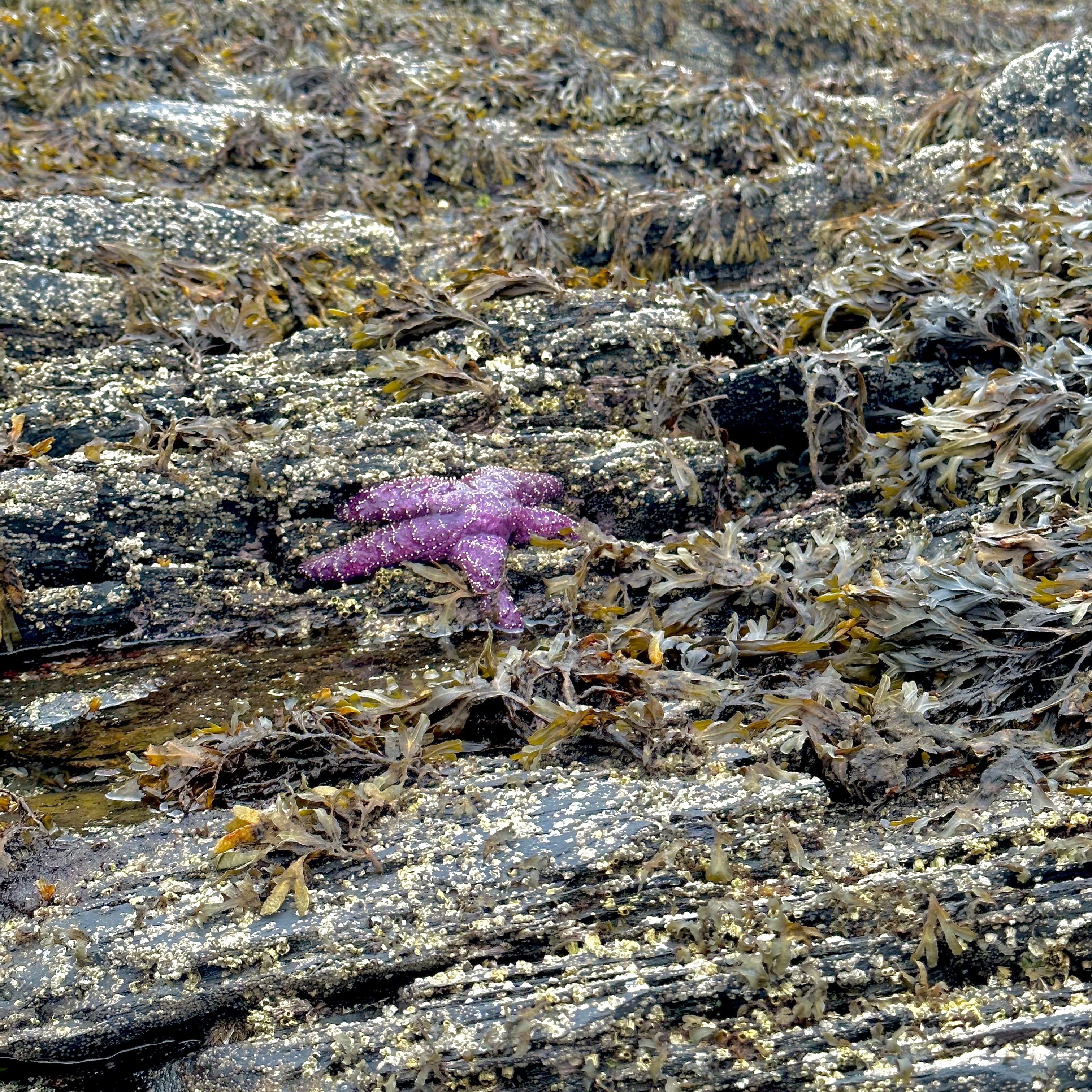
Like many sea stars, ochres can regenerate one or more arms that are severed from their central disc. Depending on water quality, food sources, and other factors, regeneration can take up to a year, but it is not uncommon to see a ochre with one arm smaller than their others.
Ochres can live up to 20 years in the wild while their lifespan in captivity is unknown. We mentioned earlier that ochres were a keystone species. It was research being done on this species and their impact on intertidal ecology resulted in the coining of this phrase, which means a species that impacts its ecological and biological community in direct and indirect ways that are out of portion with it’s biomass. The phrase also implies that there would be significant change to an ecosystem if the animal were removed. Other keystone species in various other environments include beavers, African elephants, wolves, bees, and even prairie dogs.
Resources
Caldwell, Laura, “Ochre Sea Stars,” Coastal Interpretive Center, https://interpretivecenter.org/ochre-sea-stars/. Created March 1, 2021, Accessed 17 September 2023
“Ochre Sea Star” – Oregon Conservation Strategy, The Oregon Conservation Strategy, https://oregonconservationstrategy.org/strategy-species/ochre-sea-star/. Accessed 17 September 2023
“Ochre Sea Star,” iNaturalist, https://www.inaturalist.org/taxa/49699-Pisaster-ochraceus. Accessed 17 September 2023
“Ochre Sea Star,” Rosamond Gifford Zoo At Burnet Park, https://www.rosamondgiffordzoo.org/experience/animals/invertebrates/ochre-sea-star/. Accessed 17 September 2023
Ricketts, Edward. Between Pacific Tides, Stanford University Press, Stanford, California.

Categories
tags
Subscribe to the blog
Sign up to receive weekly emails with tide pooling information and guides so you never miss a post!
 The Tide Is Out
Leave a comment