
Tide Pooling Log: Buggy’s Beach, Ketchikan, AK

The Pacific Northwest is famed for its abundance of life in the intertidal and while visiting Alaska’s inside passage, I knew I had to find a place to go tide pooling. Thanks to a helpful Luan Roberts (@Luanimal, of Nature Lookings), I found a beach near Ketchikan, far outside the touristy area that I could access by public bus. I convinced my husband and my mom to go with me once we were there; the rest of our group preferring to stay in town.
While the rest of our vacation had been characterized by sleeping in and relaxing, this morning involved getting up within the 6 o’clock hour to disembark our ship. Instead of browsing the tourist shops or going to the famous Lumberjack show, we boarded a public bus before 8am that we were fairly certain would take us out of Ketchikan to the south toward Saxman and to Buggy’s beach, for -1.1 ft low tide.
After the bus stopped for the passengers and driver to get a cup of coffee (we were definitely out of the tourist area now), we arrived at Rotary Park or, as the locals call it, Buggy’s beach.
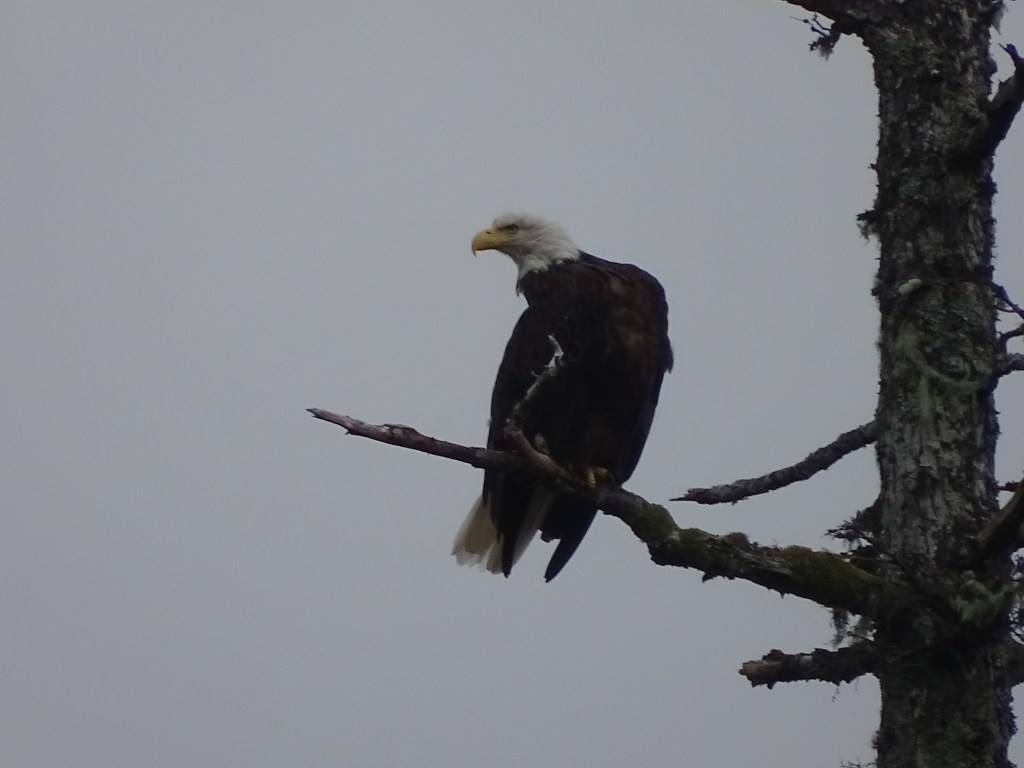
We walked passed the small playground and the large man made pool that has a sandy beach. Apparently, before Ketchikan had a public pool, locals would come here to swim because the water would “warm up” while sitting in the sun, probably to about a pleasant 60°F instead of 57°F of the sea. A few bald eagles were hanging around, leaping from tree to tree.
The low tide was excellent this morning and miraculously it wasn’t raining, but we only had a couple hours to explore. There was very little surf (if you could even call it that) on this beach as it was protected by various islands. The beach was mostly rocky with a large swath of rocks clearly above the typical high tide line, with no plant life and only a few periwinkles. A little further down there were a few hermit crabs and some brown algae. Once I got to what I thought was about the highest section of the mid-intertidal, the shore was smothered in rockweed. This algae is technically edible; I had tried some earlier on our trip, mildly salty but otherwise tasteless and crunchy like iceberg lettuce. Here I began to slow down and take in what I saw.

There is certainly something special about visiting the same tide pools over and over again. I’ve gotten to know what creatures I can expect in what pools at some of my frequent haunts. But there is something equally special in visiting an entirely new place. You don’t know the terrain or even what animals you might come across; every corner you look into provides something entirely new.
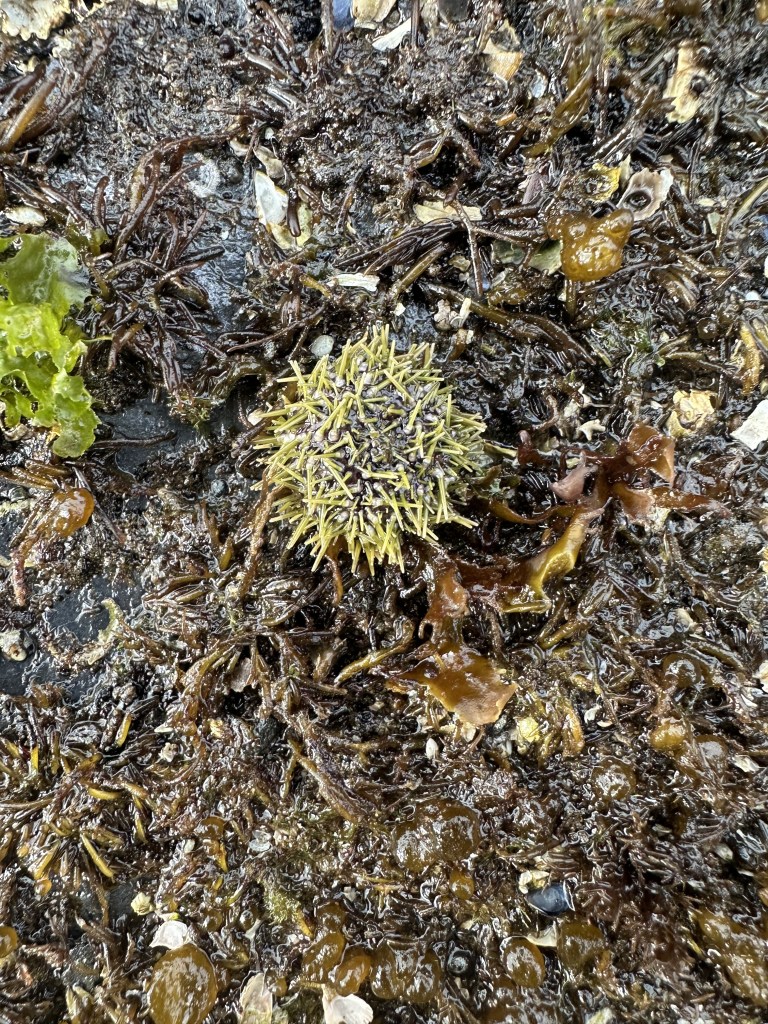
I nearly stepped on a few Arctic green sea urchins (Strongylocentrotus droebachiensis) that were exposed to air; I had never seen this species before. There were also a few tidepool sculpin (Oligocottus maculosus) in the upper pools; a cold water cousin of our typical woolly sculpin (Clinocottus analis).

As I descended further into the low intertidal, I found the sea star line. The PNW is famous for its sea stars and this beach was no exception. I saw many dozens of ochres sea stars (Pisaster ochraceus), ranging in color from clementine orange, to clay-mud red, to royal purple. Piled up by the dozens, these stars retreat at low tide to crevices and beneath overhangs to avoid drying out in the sun. I tried to find out why they form piles, often times sitting on top of one another, but couldn’t find anything. Drop a comment if you know.
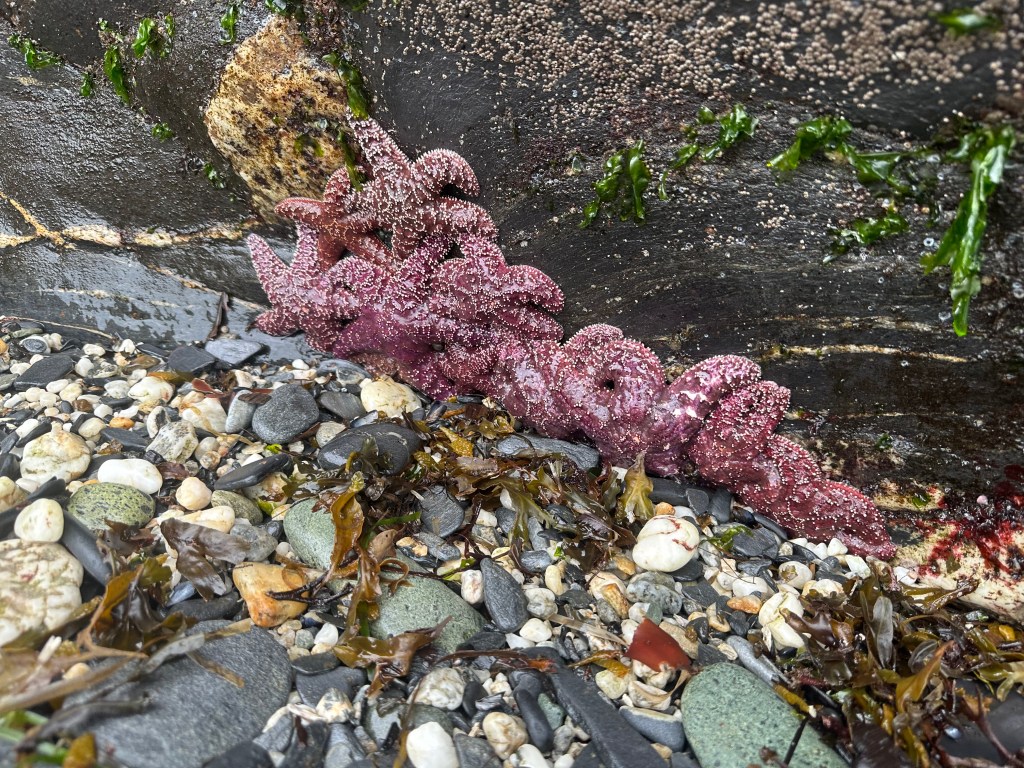
It was good to see these animals abound here after the events of sea star wasting syndrome that have devastated the eastern Pacific coast in the last 10 to 15 years. SoCal still hasn’t recovered the sea star population it had when I was a kid and seeing an ochre is a rarity. Ochre sea stars in particular are ravenous hunters and prey on mussels primarily. While my regular haunts in Orange County have giant mussels bars that mark tidal zones, there were very few mussels in Alaska, most likely due to the abundance of ochres.
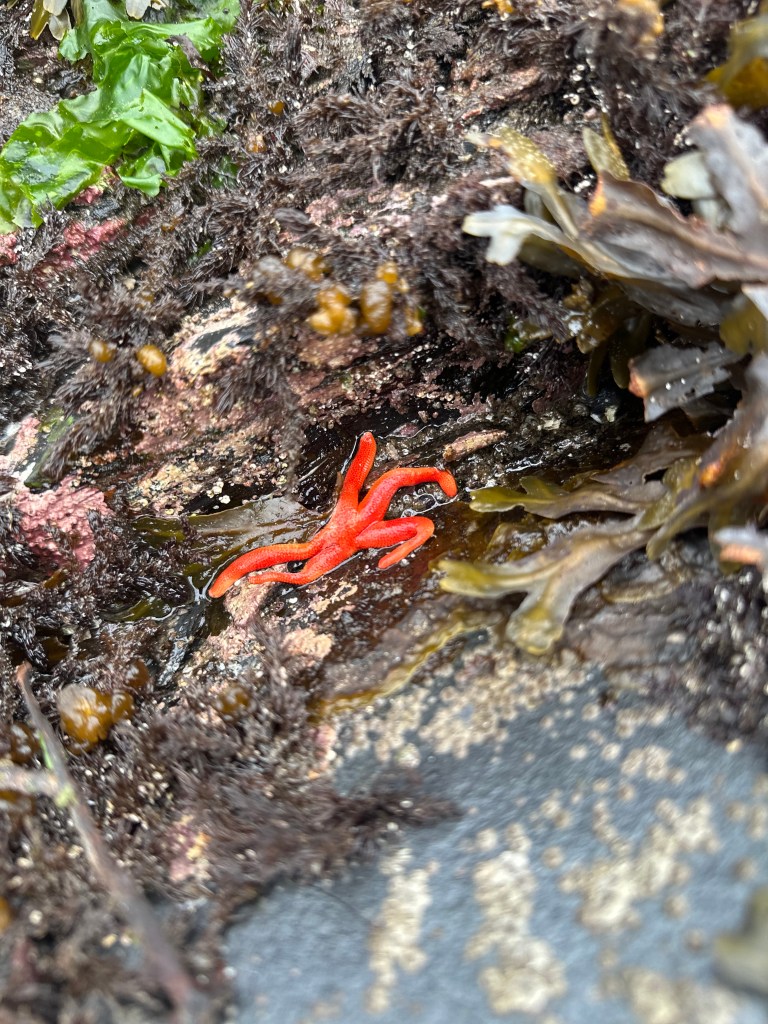
Leather stars (Dermasterias imbricata), another new to me species, abounded here as well. They don’t look particularly leathery to me; more slimy. Maybe they are supposed to look like wet leather. But by far my favorite stars I saw were two gorgeous, bright crimson red Pacific blood stars (Henricia leviuscula). Even nudibranchs with their bright colors pale in comparison to these brilliantly red sea stars.

Speaking of nudibranchs, this beach is home to a large population of these slugs, including the barnacle-eating dorid (Onchidoris bilamellata) and, the one I wanted most to find, the Nanaimo dorid (Acanthodoris nanaimoensis), which boasts red rhinophores and a white body with iridescent yellow tips. Unfortunately, I didn’t see either as I probably wasn’t sure what I was looking for with the barnacle-eating dorid (they are often out of the water with their barnacle prey at low tide) and ended up looking too quickly to see a Nanaimo.

However, my mom spotted these three Monterey dorids (Doris montereyensis) piled up on each other out of the water on a rock facing the sea; a beach with any kind of wave shock would have made sure these slugs couldn’t hold on there, but on this quiet beach they were safe.
I also spied this hairy spiny dorid (Acanthodoris atrogriseata) out of the water as a small white blob. I was afraid it was dead, but when I submerged it, it ruffled out its small cerrata and began moving. It wasn’t until later that I was able to ID this little guy after originally think it was a Hudson’s horned dorid (Acanthodoris hudsoni). It wasn’t as beautiful as the Nanaimo I wanted to see, but it was still a new-to-me species and quite lovely.

Being a little over 2000 miles north of where I am accustomed to tide pooling, Alaska obviously had a wide range of fauna that I had never seen before. While some species and groups overlapped, many others simply had no shared species that I would see at home. Crustacea is certainly one of these families. No blueband hermit crabs or striped shore crabs were to be seen, which are the two most common species in SoCal. Pacific hairy hermit crabs (Pagurus hirsutiusculus) took the place of bluebands, and the “shore crab” equivalent in number and seemingly ecological function were graceful kelp crabs (Pugettia gracilis) and northern kelp crabs (Pugettia producta).

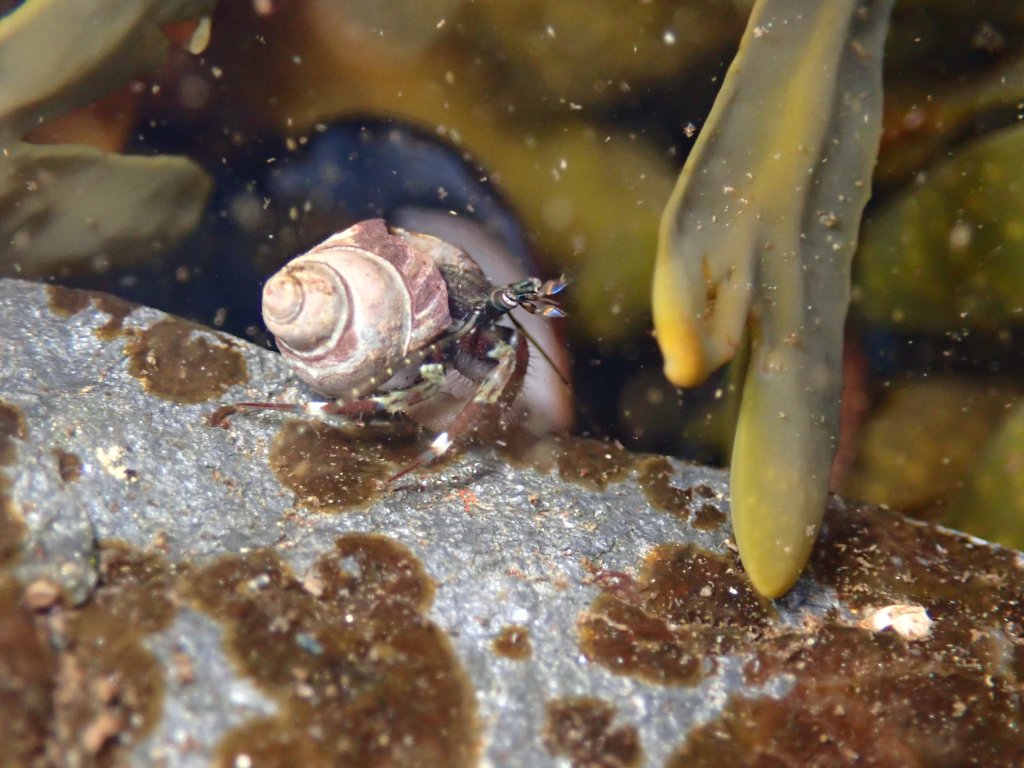
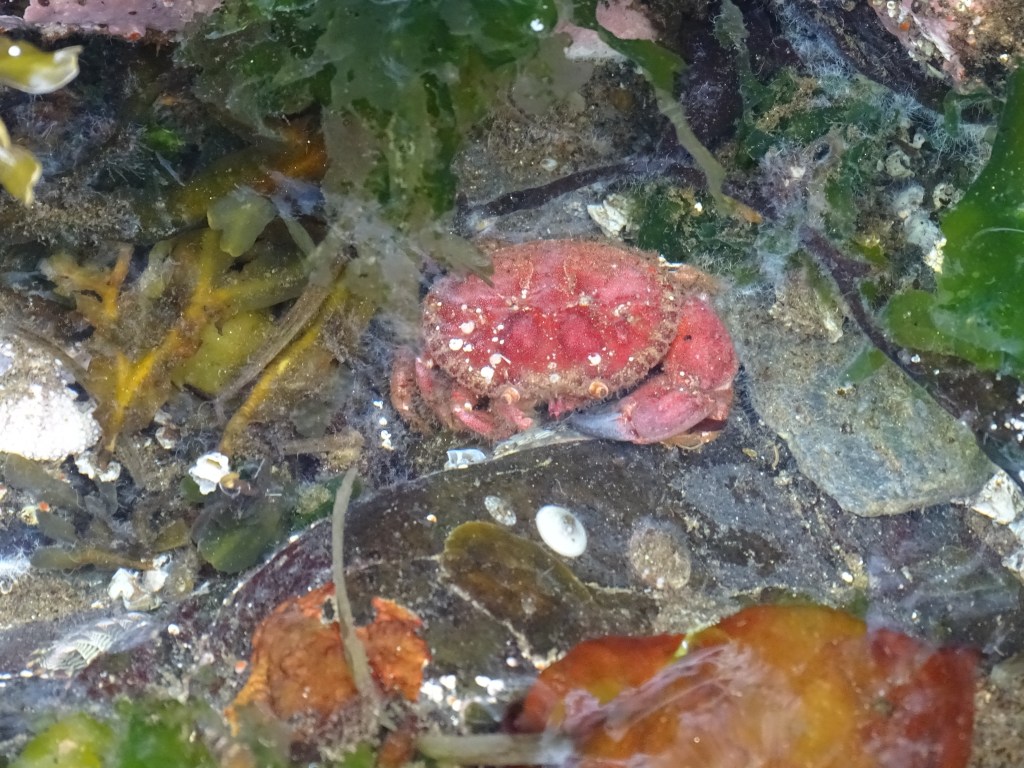
These semi-decorated crabs were literally under every section of seagrass that I moved; I just stopped taking pictures of them. Both species were small, about 4 to five inches across including their legs. The northern kelp crabs looked the same as they do down south, but the graceful kelp crabs looked like a cross between kelp crabs and decorator crabs with a few pieces of algae suck onto them at odd angles. They mostly skidded away when I tried to bring my camera near, but eventually got used to me and stuck around for me to take pictures. We also saw red rock crabs (Cancer productus) and pygmy rock crabs (Glebocarcinus oregonensis), both new-to-me species.

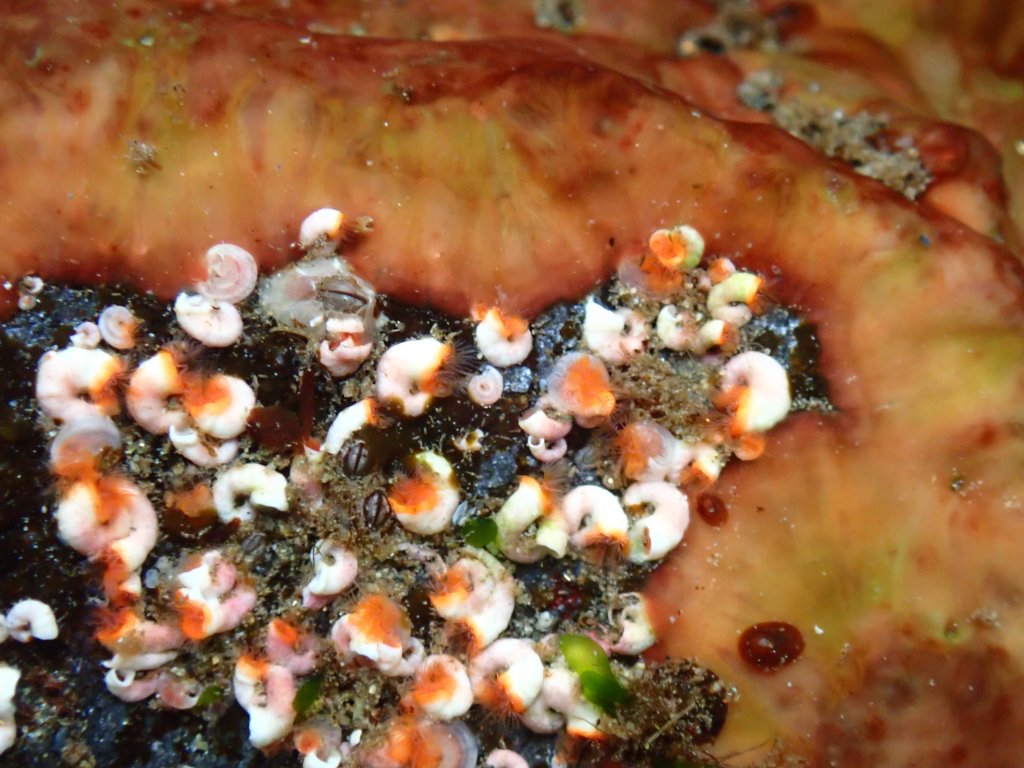
Another defining difference of these tide pools was the sheer abundance of spiral tube worms (Subfamily Spirorbinae), tiny calcareous worms with orange or light pink radioles. They are so tiny that you have to look extremely close or have a powerful macro camera to see make out what they are. In SoCal, they guys are scattered about among the algae and other substrate, but in Ketchikan, they were the substate. Nearly every inch of rock that wasn’t covered in barnacles was covered in spiral tube worms. They took the place of the algae that I am used to.
Buggy’s beach was also characterized by echinoderms (sea stars and urchins) instead of cnidarians (anemones). My mom saw a couple anemones and I may have seen a few that were closed up, but they were very sparse.
Of course, this wouldn’t be a complete tide pooling log if I didn’t mention the chitons. These plated mollusks come in a variety of shapes and sizes. I saw mostly lined chitons (Tonicella lineata) that boast intricate patterns and colors. My mom was lucky enough to see a gumboot chiton (Cryptochiton stelleri). She tried to call to me but I was too far to hear and come see her find.


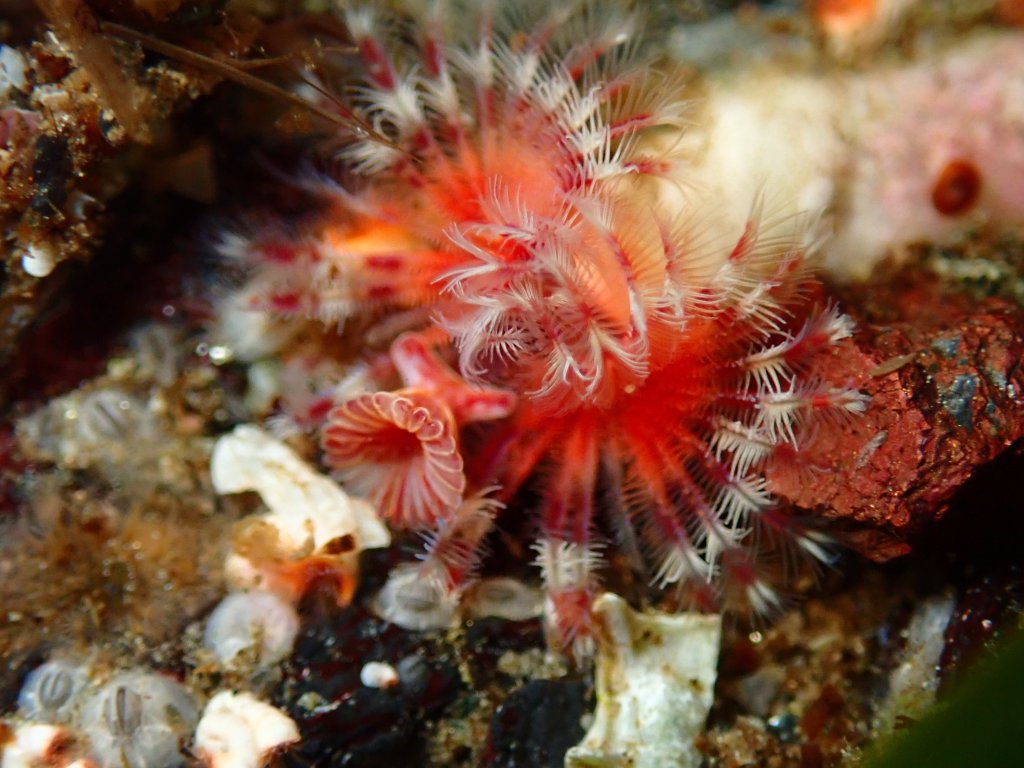
There were also a few polychaete worms I have never seen, including a red trumpet calcareous worms (Serpula columbiana) and a few yoke-bearer calcareous tubeworms (Crucigera zygophora). A very helpful Leslise Harris on iNat provided the ID of the latter. These worms were very prevalent and simply stunning in both color and patterns.


I only had a few hours to explore here before we had to head back into town. It seemed like only 15 min. The tide pools were extensive and I think I may have been about 10% of what there was to see. The air was chilly, but we were lucky it still wasn’t raining and a moderate, unzipped jacket was all I needed. I nearly slipped on the rock weed walking back to the beach. We had to make the bus and were already pushing it. Of course, there were many more animals that we saw I didn’t get to mention here, but even so there was so much to see.


Categories
tags
Subscribe to the blog
Sign up to receive weekly emails with tide pooling information and guides so you never miss a post!
 The Tide Is Out
Leave a comment